

Article summary
Freight Forwarder vs Broker at a Glance
- What it is: A licensing question. A freight forwarder moves your cargo. A customs broker holds the CBP license to file the entry that admits it.
- Why broker is confusing: Inside the US it means an FMCSA freight broker who books trucks. Across a border it means a customs broker licensed under 19 CFR Part 111.
- Where the line sits: A forwarder can assemble your documents but cannot classify, value, or file the entry unless it holds a CBP broker license of its own.
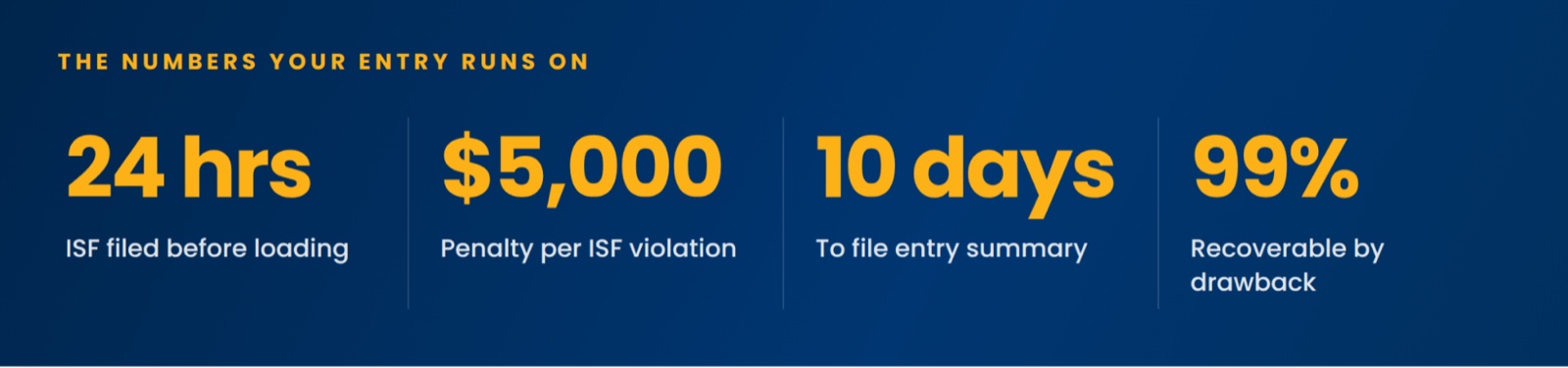
- The deadlines that matter: ISF must be accepted 24 hours before loading, with liquidated damages up to $5,000 per violation. The entry summary and duties follow within 10 working days of release.
- Where to start: Keep two providers for a handful of entries on one lane. Put them on one team when freight is time-bound, multimodal, or regulated.
Kesco
Who files your customs entry? Freight forwarder vs broker is not a trivial question you want to be debating once your container is on the ground and you’re back and forth between the two.
A freight forwarder arranges and manages the physical movement of your cargo. A customs broker holds the CBP license to file the entry that admits it legally. Two jobs, two licenses, and the word broker means something different again once your freight stays inside the country.
Two providers means two systems, and you own the cost either way.
The forwarder holds the container data while the broker holds the filing authority. When those sit at two companies, you’ve got security filings waiting on an email while the arrival notice reaches the wrong inbox, and the free-time clock runs on the terminal’s calendar regardless.
Below: what each role owns, why broker means two things, the six steps of clearance, and how to decide whether yours should be one company or two.
Work with Kesco
One team moving your freight and filing your entry.
No handoff between your container data and your filing authority. Send us your lanes and commodities.
Get a QuoteFreight Forwarder vs Broker: Which Are You Asking About?
Let’s start with the word “broker” itself, because it does two unrelated jobs depending on where your freight is going.
- Inside the US, broker means freight broker. A company registered with the FMCSA that matches your truckload or LTL shipment with a motor carrier and negotiates the rate. It never takes possession of the goods and has no authority over a customs entry.
- Across a border, broker means customs broker. A person or company licensed by CBP to classify your goods, declare their value, and file the entry in your name. It has no role in finding you a truck.
The two share a word and nothing else. So the difference between freight forwarder and broker depends entirely on which broker you mean.
| Role | What they handle | Who licenses them |
|---|---|---|
| Freight forwarder | Booking ocean, air, and inland capacity, consolidation, house bills of lading and air waybills, routing, tracking, cargo insurance, delivery | FMC, as an ocean transportation intermediary, plus IATA accreditation for air |
| Customs broker | HTS classification, valuation, duty and fee calculation, ISF and entry filing, partner agency clearance, bonds, post-entry corrections and refunds | CBP under 19 CFR Part 111, after a licensing exam and background investigation |
| Freight broker | Matching domestic truckload and LTL freight with motor carriers, rate negotiation, load tracking | FMCSA, with a $75,000 BMC-84 surety bond |
Sources: Federal Maritime Commission, 19 CFR 111.2.
For anything crossing a border, the comparison that matters is freight forwarder vs customs broker. A forwarder moves the cargo and a customs broker files the entry, even when a forwarder’s website describes its service as “end-to-end.”
Forwarders have a different role entirely.
What a Freight Forwarder Does (and Where the Job Ends)
A freight forwarder works from your purchase order and the supplier’s ready date.
It picks the mode, books space with the carrier, and issues its own house bill of lading or air waybill. If your cargo does not fill a container, the forwarder consolidates it with other shippers’ freight at origin and deconsolidates it at destination.
In the US, freight forwarding by ocean requires an FMC license as an ocean transportation intermediary and proof of financial responsibility before a company can offer the service at all.
Day to day, the forwarder owns:
- Routing and carrier selection: Mode, lane, and carrier across ocean freight, air, and inland trucking, including the FCL versus LCL call and any air-to-ocean decision.
- Origin work: Supplier pickup, export documentation, warehouse receiving, and container loading.
- The transport documents: House and master bills, packing list review, and the commercial invoice check that feeds the entry later.
- Tracking and exceptions: Milestone alerts, plus rebooking when a vessel rolls or a flight bumps the cargo.
- Destination handling: Cargo insurance, drayage, final delivery, and appointment scheduling at the consignee.
Where a forwarder’s job stops
Everything above happens before the entry is filed. That is where a forwarder’s authority runs out.
- It can assemble the document package: Invoice, packing list, bill of lading, certificates.
- It can collect your importer number and power of attorney. Then hand both to a broker.
- It cannot classify your goods, declare a value, or file the entry. Not unless it holds a CBP broker license itself.
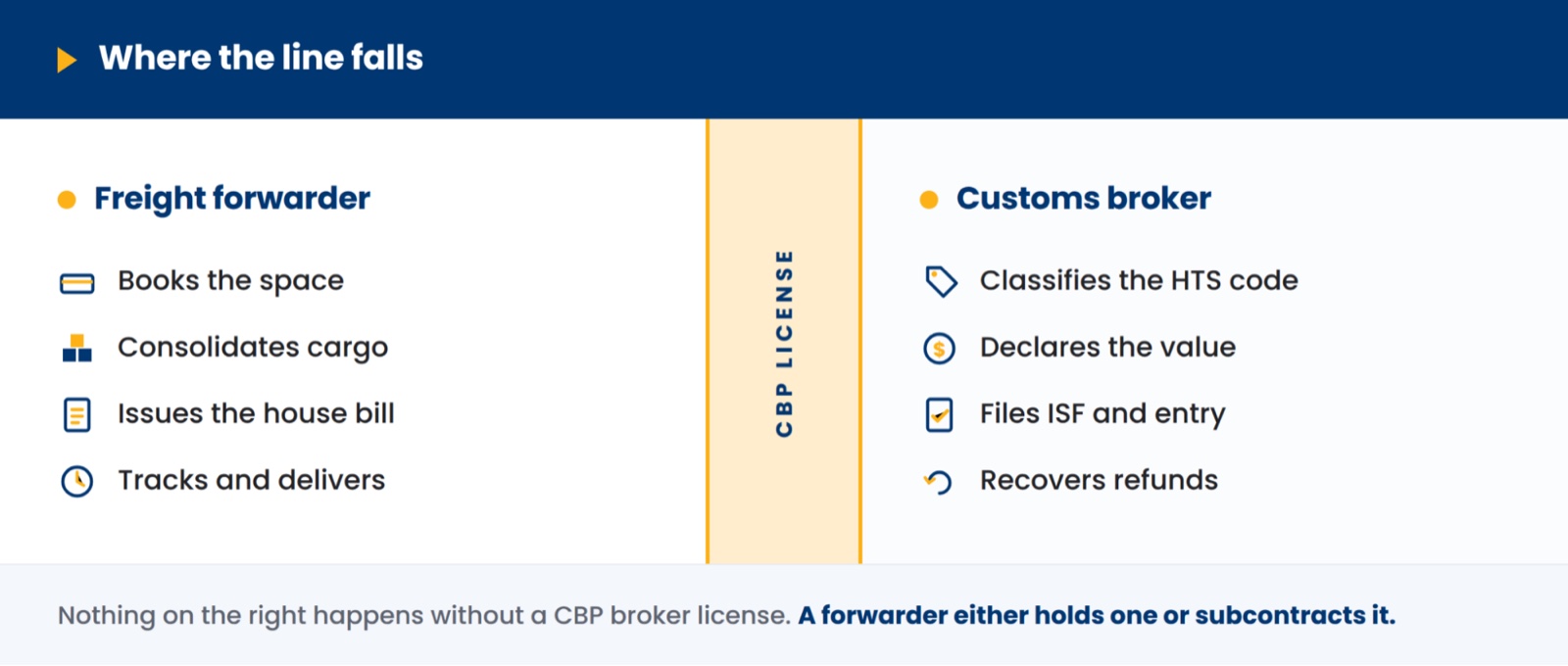
Some large forwarders own a licensed brokerage division. Many don’t, and the customs clearance line on their quote is a subcontract to a broker you have never met. Under 19 CFR 111.2, anyone transacting customs business on behalf of another party must hold a CBP broker license.
Which raises the obvious question: what does that license actually buy you?
What a Customs Broker Does That a Freight Forwarder Legally Cannot
Customs business covers classification, valuation, duty calculation, and the filing of entries, so the four jobs below stay with a licensed broker no matter how full-service the forwarder’s proposal reads.
1. Classification sets the duty rate, and one wrong digit changes the bill
The broker assigns the 10-digit HTS code that decides the base duty rate and whether Section 301, Section 232, reciprocal tariffs, or antidumping and countervailing duties stack on top of it. Getting there takes more than reading the supplier’s invoice:
- Spec review: the broker reads product specs, materials, and end use, since the same item can fall under two headings with different rates.
- AD/CVD screening: every code gets checked against active antidumping and countervailing duty orders, which carry their own deposit rates on top of regular duty.
- Binding rulings: when a classification is arguable, the broker asks CBP to settle the rate before the first entry rather than after.
- A SKU-level catalog: the same part gets classified once, so it does not get entered three different ways by three different clerks.
Misclassification is one of the enforcement priorities named in Executive Order 14411 on customs enforcement, which also directs CBP to narrow the penalty mitigation importers have relied on. A rushed classification is the most expensive line on the entry.
2. Valuation and duty calculation decide what you owe, and the broker signs the declaration
The declared value is the base every duty and fee gets multiplied against, and CBP has specific rules about what belongs in it. The broker handles:
- Transaction value: the broker applies the valuation rules and adds assists, royalties, and packing costs that count as dutiable.
- Duty and fee calculation: duty plus the merchandise processing fee, the harbor maintenance fee on ocean cargo, and any tariff layers that stack on top.
- Data reconciliation: the invoice value has to match the payment terms and the ISF data already on file with CBP.
- Bond coverage: the entry posts against your continuous bond, or the broker arranges a single-transaction bond for a one-off import.
The importer of record is legally liable for the declaration. The broker is the licensed professional who prepares it and answers to CBP for its own conduct, which is why the broker’s name goes on the entry.
3. Entry filing and agency clearance decide whether the container moves or sits
The broker transmits the entry through ACE and manages every agency with a say in release. That means:
- Entry type: a Type 01 formal entry, or a Type 11 informal entry when the shipment is at or under $2,500 and not subject to AD/CVD.
- Agency flags: partner government agencies get their own filings, including FDA prior notice, USDA, EPA, CPSC, and FCC, depending on the commodity.
- Exams and document requests: the broker answers CBP inquiries and coordinates the exam when a shipment is targeted.
- Release tracking: the broker watches release status and clears the terminal hold so the trucker can pull the container.
This is the step where a forwarder without a license and a broker without freight visibility both go quiet, because each assumes the other has the arrival notice.
Work with Kesco
Our customs broker license is in house at every US port.
The person who booked your container works next to the person who files your entry.
Get a Quote4. Post-entry work recovers money, or leaves it with CBP
The broker’s job continues after release, and this stage is where a split setup quietly costs the most:
- Post-summary corrections: the broker fixes a classification or value that was wrong on the original entry, before liquidation closes it.
- Liquidation and protests: tracking liquidation dates, filing protests, and closing out reconciliation entries when values were provisional.
- Duty drawback: claims can recover up to 99 percent of duties paid on goods that are later exported or destroyed.
- Recordkeeping: entry records stay on file for the five-year retention period CBP requires.
A forwarder that hands off brokerage never sees this stage, so refund opportunities tend to die in the gap between providers.
Every one of those jobs sits inside a sequence with hard deadlines, and the sequence is where split setups fail.
The Customs Clearance Process, Step by Step, and Where a Split Setup Breaks
Regardless of whether one company or two handles it, the customs clearance process runs in the same order. The difference shows up in who holds the data each step needs.
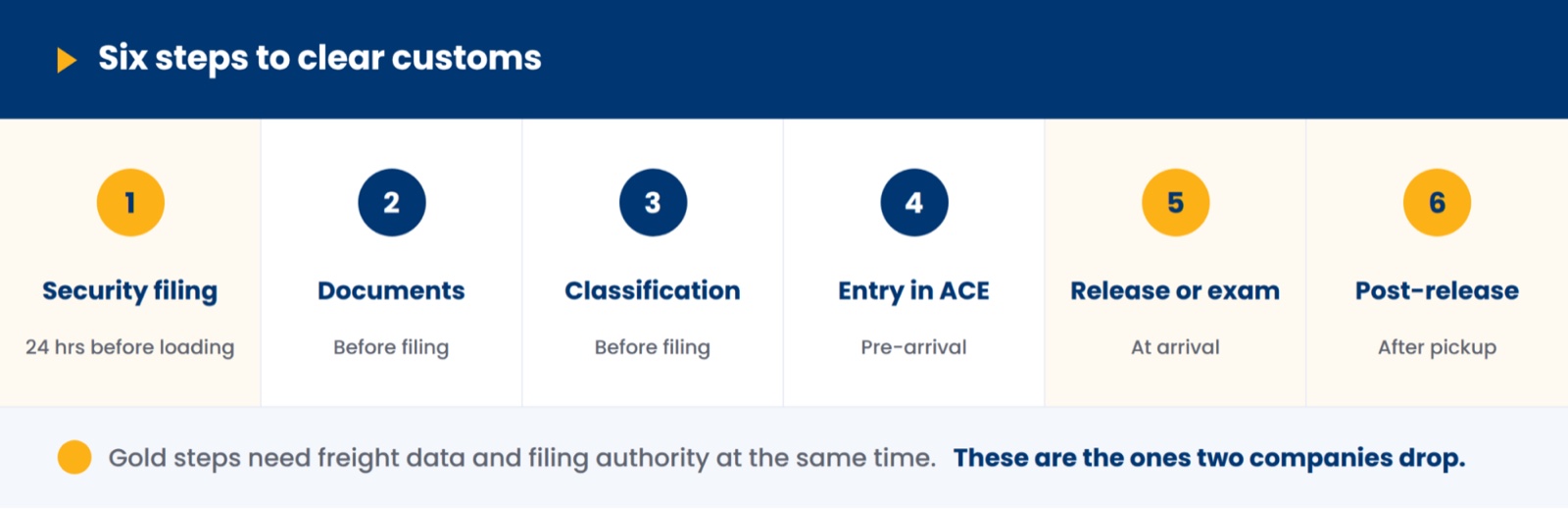
1. The security filing goes in before loading
For ocean cargo, the Importer Security Filing must be accepted by CBP at least 24 hours before the container is loaded at the foreign port, and a late or inaccurate filing exposes you to liquidated damages of up to $5,000 per violation. The forwarder holds the stuffing location, consolidator, and bill of lading numbers. The broker files. When those are two companies, the filing waits on an email.
2. The document package gets reviewed before anything is transmitted
Commercial invoice, packing list, bill of lading or air waybill, and any certificates of origin or agency forms. Mismatches between the invoice and the ISF get caught here, or they surface later as a CBP inquiry.
3. Classification and valuation get locked in
The broker confirms the HTS code and dutiable value and screens for AD/CVD, Section 232, and reciprocal tariff exposure before anything is transmitted.
4. The entry goes through ACE
The entry (CBP Form 3461) goes through ACE, usually before arrival for ocean freight, and the entry summary (Form 7501) with duties follows within 10 working days of release.
5. Release depends on targeting
Electronic release is the common outcome for clean, pre-filed entries. When CBP targets the shipment, the broker handles the documentary review or coordinates a physical exam at a centralized examination station, which adds days plus exam and drayage fees. Importers in a CTPAT-validated supply chain see fewer exams.
6. Post-release work starts when the container leaves
Delivery order to the trucker, terminal pickup inside free time, then the corrections, protests, and drawback work described above.
Conclusion: Nobody Owns the Handoff
The security filing, the release, and your free time at the terminal all depend on freight data that sits with your forwarder and filing authority that belongs to your customs broker. When those are two different companies, nobody gets an alert when the other one is late, and the first notice you get is the demurrage invoice.
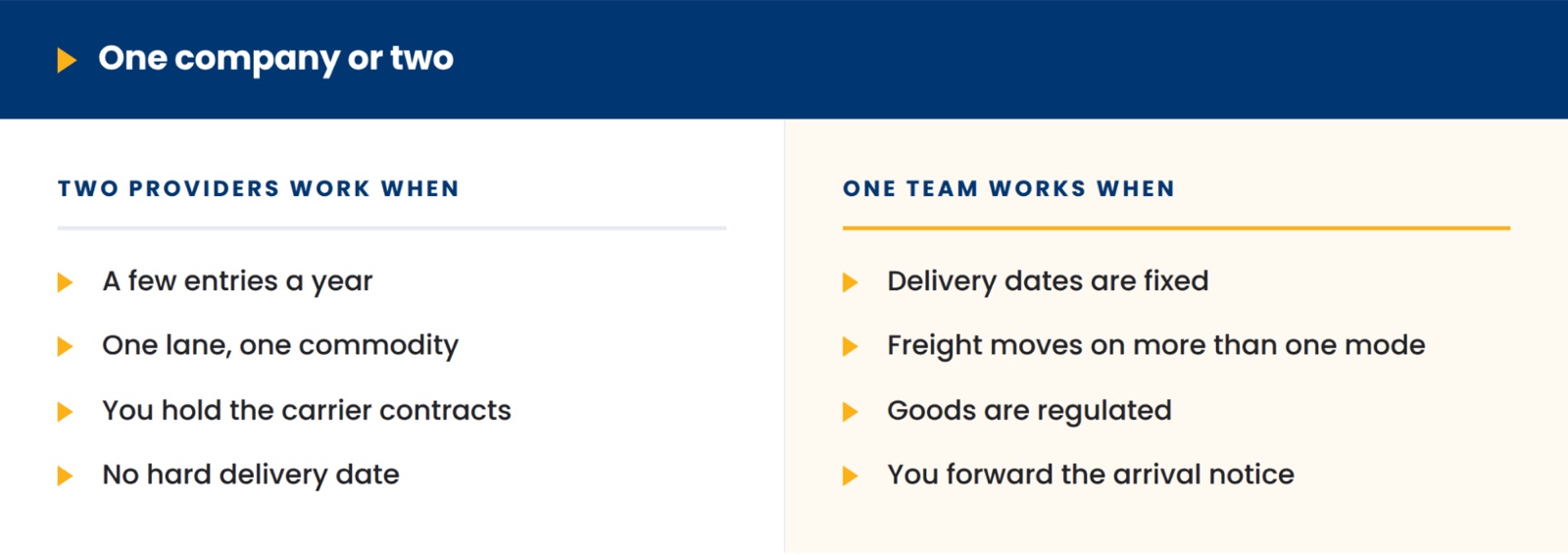
So the real question was never forwarder vs broker. You need both. What you get to decide is whether both sit under one roof.
Kesco is an employee-owned freight forwarder with its CBP customs broker license in house at every U.S. port. The people who book your container file your entry, and customs status sits beside vessel milestones in the Kesco Platform, so there is no handoff to chase. If your freight and your entries are on two different desks today, tell us your lanes, modes, and commodities and get a quote.
Freight Forwarder vs Customs Broker: Frequently Asked Questions
Is a freight broker the same as a customs broker?
No. A freight broker is registered with the FMCSA, arranges domestic truck capacity, and backs the arrangement with a $75,000 surety bond. A customs broker is licensed by CBP under 19 CFR Part 111 to classify goods, declare value, and file entries on an importer’s behalf. If your freight crosses a border, the broker you need is the customs broker, and a freight broker has no role in clearance.
Can a freight forwarder clear customs?
Only if the forwarder, or a subsidiary it owns, holds a CBP customs broker license. Without one, the forwarder can collect and forward your documents, but it cannot classify, value, or file the entry, so any “customs clearance” on its quote is being subcontracted. Ask which licensed entity will appear as the filer on your entry summary. The answer tells you who is accountable.
Do I legally need a customs broker to import into the US?
The license requirement applies to anyone transacting customs business for someone else, so an importer filing on its own account can self-file without a broker. In practice, self-filing means ACE access, a continuous bond, and staff who can classify and value goods correctly. For formal entries above $2,500 and for anything touching a partner agency, a licensed broker is the standard because the penalties attach to the importer of record.
What is the difference between freight forwarding and customs clearance?
Freight forwarding covers the physical move: booking, consolidation, transport documents, tracking, and delivery. Customs clearance covers the legal admission: security filings, classification, valuation, entry, duty payment, and agency release. A single shipment needs both, and the customs clearance process runs on fixed deadlines, such as the ISF 24 hours before loading, that depend on freight data the forwarder holds.
Who is liable when a customs broker misclassifies a shipment?
The importer of record. CBP assesses additional duties and any negligence penalties against the importer, who can then pursue the broker under their service agreement. Brokers also answer to CBP for their own conduct and can face penalties under Part 111. That is why importers want a broker who classifies from product specs and keeps a SKU catalog, rather than one who copies the code off the supplier invoice.
How long does the customs clearance process take?
Release path matters more than mode. An entry filed before arrival with clean, matching data can be released electronically at arrival, so the container or airline pallet is available as soon as the terminal processes it. A documentary review adds days, and a physical exam adds more, plus exam and drayage fees. The lever you control is filing early with invoice, ISF, and entry data that agree with each other.
Is it cheaper to use separate providers for freight forwarding and customs clearance?
On the invoice, sometimes. The per-entry fee at a standalone broker can come in under a forwarder’s bundled rate, especially at low volume. The costs that do not appear on that quote are demurrage from a late release, exam fees nobody coordinated, and duplicate data entry across two systems. Compare total landed cost across a quarter, including storage and detention, before deciding on the entry fee alone.
How do I choose between a customs broker and freight forwarder for my imports?
The difference between freight forwarder and broker starts with the shipment. If your freight stays inside the US, you need a carrier or a freight broker and no customs broker. If it crosses a border, you need both a forwarder and a licensed customs broker, and the decision is whether they should be the same company. Importers who hold their own carrier contracts sometimes want brokerage alone, which is why Kesco offers customs brokerage on a standalone basis and runs a Control Tower model on client contracts, while everyone else gets both under one team.
Work with Kesco
Get a freight quote that includes the entry.
Moving freight since 1989. FMC licensed, IATA certified, employee owned.
Get a Quote